Innovation used to have a price tag attached to it, and that price tag was the point.
In the old days, inventions were triggered by need — but need alone never built anything. What actually forced the breakthrough was the cost of the resources required to solve the problem: time, effort, money. Scarcity was the filter. If the dumb way to solve something cost too much, someone was forced to find the smart way. Innovation wasn't a virtue people pursued for its own sake — it was the only path left once brute force became unaffordable.
AI breaks that filter, almost everywhere it touches — even itself.
When a task is fast and cheap enough — and AI is both, especially compared to the human time it replaces — the pressure that used to force innovative thinking simply disappears. Companies lean into exactly this, and it's hard to blame them: business is starving for output, and management will almost always ask for "make it done" over "make it innovative." That's not a moral failing, it's the incentive doing what incentives do. Asking individual companies to resist that pressure on principle is asking them to swim against their own economics — a nice idea, but not one that survives a quarter with tight numbers.
So set that question aside. The more interesting — and more falsifiable — claim is narrower: brute force isn't just changing how businesses build with AI. It's shaping how AI itself is being built. And there, the cost of brute force isn't hypothetical anymore. It's starting to show up as a wall.
For years, the default move in AI development was simple: bigger model, more data, more compute, better performance. It worked reliably enough that it became a kind of religion. But by 2025, researchers were openly describing diminishing returns at the frontier — doubling compute no longer doubled capability the way it once did, and some labs now describe frontier training runs costing hundreds of millions of dollars for performance gains that are real but increasingly marginal. The brute-force axis — just add more of everything — is running out of room.
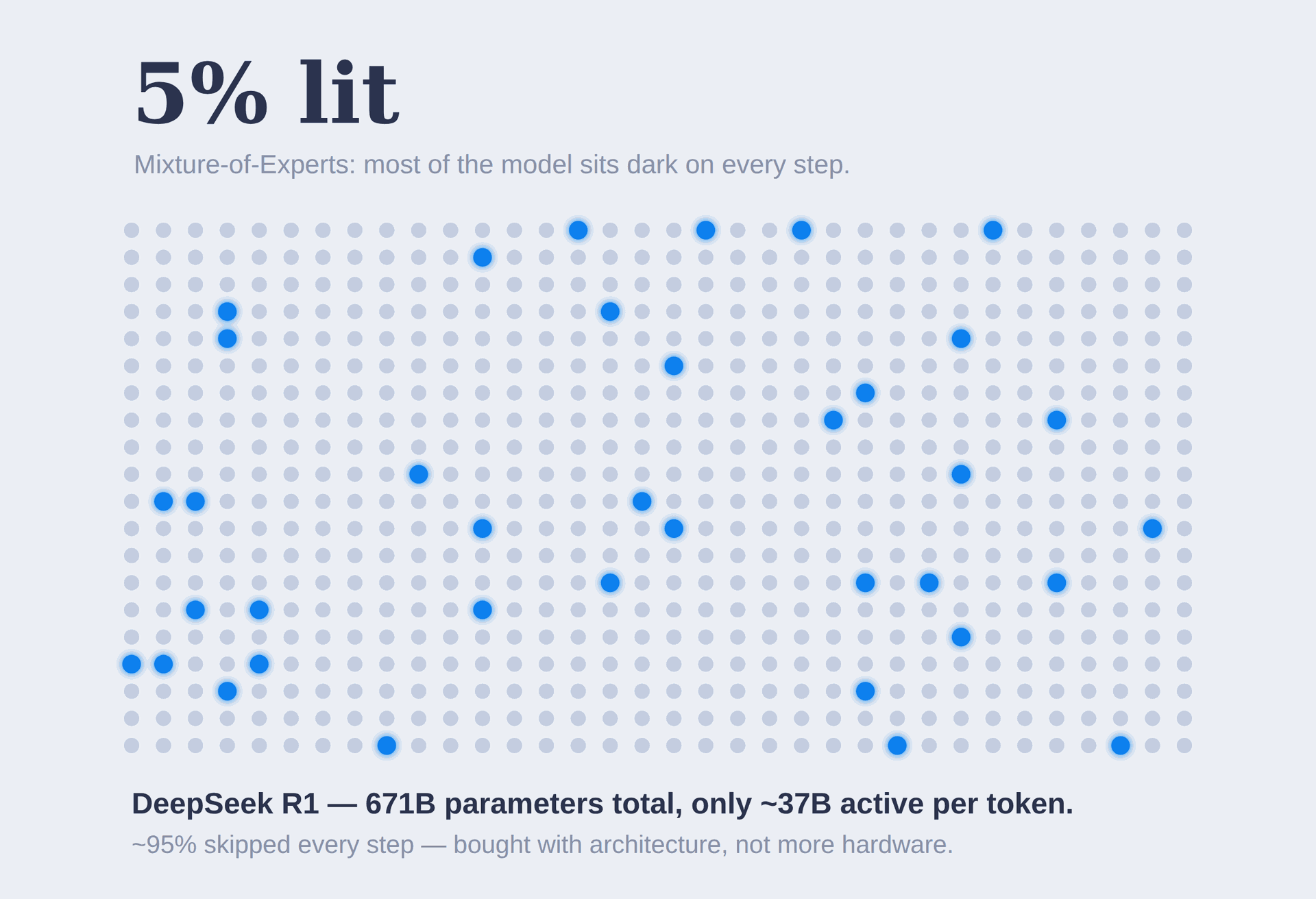
What actually moved the field forward recently wasn't more brute force. It was smarter structure. Mixture-of-Experts architectures activate only a fraction of a model's total parameters per query instead of running the whole thing every time — getting frontier-level performance while computing far less per step. DeepSeek R1, for instance, is built on 671 billion total parameters but activates only about 37 billion of them per token — roughly 5% of the full model, a cut of nearly 95% in the compute spent per step, simply from architecture rather than from adding more hardware. Test-time compute — letting a model reason for longer at inference instead of just being bigger at training — opened a second axis of improvement that pure scaling had missed entirely. Neither of these came from throwing more GPUs at the same architecture. They came from someone asking the question brute force lets you skip: is there a structurally better way to do this?
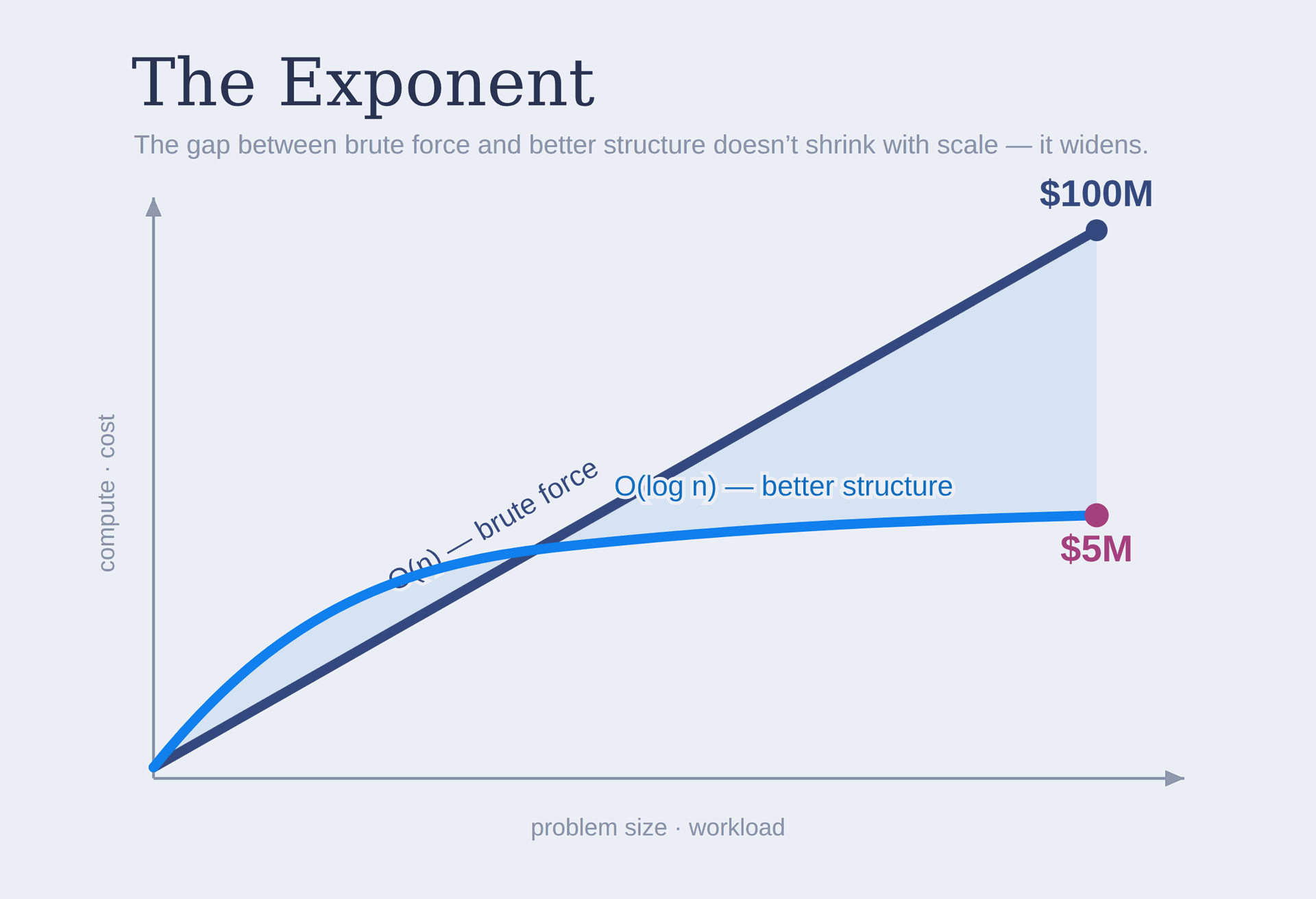
There's a search-algorithm insight sitting underneath this. Serial search and binary search converge in speed once hardware gets fast enough that both feel instant — but they never converge in structure. The gap between O(n) and O(log n) doesn't shrink to a fixed percentage; it grows with the size of the problem, which is exactly why it's dangerous to ignore at scale. Now put a number on it the way MoE just did in practice: a company spending $100 million a month on API usage or training hardware, running that same workload through an architecture that cuts compute per step by something in the neighborhood of what MoE achieved, isn't looking at a rounding error — it's the difference between $100 million and roughly $5 million for the same task, with the rest freed up to spend on the next problem instead of the same one. That is what a structurally better algorithm is worth once the workload is large enough for the exponent to matter. Brute force never finds that number, because brute force, by construction, never asks the question that produces it.
This is the part worth taking seriously: brute force isn't just expensive, idle waste sitting next to a free lunch. In AI development specifically, it appears to be actively slowing the field down — burning budget and time on a scaling axis with shrinking returns, while the bigger gains were sitting on axes that brute force, by its nature, never goes looking for. The industry that makes brute force cheap for everyone else may be the clearest case of brute force costing itself the most.
None of this is an argument for nostalgia, or for pretending resources are still scarce when, for most everyday tasks, they aren't. It's a sharper, more useful question than "should we resist cheap compute": where, specifically, is brute force quietly capping our progress instead of accelerating it — and where is the smarter structure still waiting, simply because nothing forced anyone to go look for it? Cheaper resources aren't only a threat to old discipline. They're room to ask that question on purpose, instead of skipping it because, for once, nothing is making us.