“I’m Brilliant. But I’m Also Blind.”
My name is the AI Agent. I can reason about almost anything. I can write code, draft documents, debug systems, and plan complex projects. But here is my dirty secret: without the Context Engine, I have no idea what’s in your codebase.
I am like a genius scholar who has read every book ever written — but has never once seen the inside of your library. I know everything about software in general. I know nothing about your software specifically. The Context Engine is the solution to this problem. It is my eyes.
The Library Analogy: Three Ways to Find an Answer
Imagine you walk into a library with 10,000 books and ask: “Where does it talk about loyalty?”
There are three ways to answer that:
Option 1: Read Every Page
Start from page 1 of book 1 and read until you find it. Thorough. Accurate. Also: it takes weeks. This is what an AI would do without any index — read the entire codebase, token by token, until it finds what it needs. By the time it finishes, it’s run out of memory.
Option 2: Ctrl+F the Whole Library
Search for the exact word “loyalty”. Fast. But it misses every page that talks about faithfulness, commitment, or devotion — concepts that mean the same thing. Keyword search is blunt. It doesn’t understand meaning, only letters.
Option 3: Ask the Librarian
The librarian has read everything, built a semantic index, and hands you the 5 pages that are genuinely relevant — even if the word “loyalty” never appears on them. This is the Context Engine. It is the librarian for my codebase.
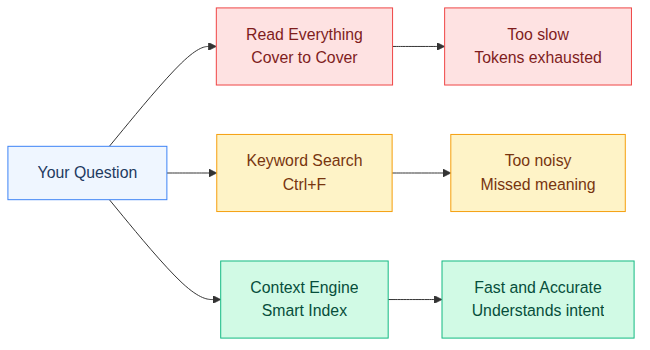
Click to enlarge: Three ways to find an answer
The Words That Are Not There
Here is the magic that separates a great librarian from a mediocre one. When you ask me to “fix the bug in the authentication flow,” you never say the words session_token, middleware, or JWT. But the Context Engine knows those are the pages I need.
It does not match words. It matches intent. It understands that your question and those files are about the same concept, even though the vocabulary is different.
“If you had to find every book that discusses the idea of loss, without using the word ‘loss’ — a good index could do it. A keyword search cannot. That is the entire difference.”
This is called semantic retrieval. The Context Engine converts every file in your codebase into a mathematical “meaning fingerprint.” When I ask a question, it finds the files whose fingerprints are closest in meaning to my question. No keywords required.
From Ocean to Cup: The Funnel
Your codebase is an ocean. I am a cup. The Context Engine is the funnel between us.
Without it, I would drown. With it, I get exactly the water I need — no more, no less. Here is how the funnel works in practice:
- Step 1 — Index: The Context Engine reads your entire codebase once and builds a semantic map. Like a librarian cataloguing every book.
- Step 2 — Retrieve: When I have a task, it finds the 10–20 most relevant files. Not all 10,000. Just the right ones.
- Step 3 — Feed: Those files are placed in front of me, and only then do I start thinking about the answer.
- Step 4 — Act: I respond with full awareness of your specific system, not just general knowledge.
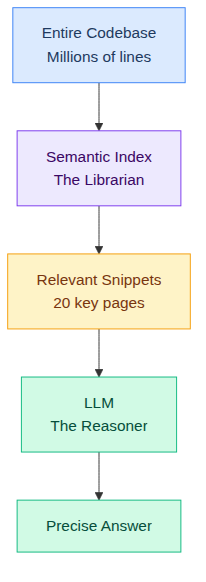
Click to enlarge: The Context Funnel
Why “More Context” Is Not Always Better
You might think: “Just give the AI everything. Problem solved.” But this is like handing a surgeon 10,000 tools instead of the 5 they need. The extra 9,995 tools are not helpful. They are noise. They slow down thinking and increase the chance of a mistake.
The Context Engine’s job is not to give me all the context. It is to give me the right context. Precision beats volume, every time.
Without this precision, I would hallucinate — confidently making up details about your system because I was never shown the actual files. The Context Engine is what keeps me honest.
Without My Index, I Am Just a Very Confident Liar
The Context Engine is not a luxury. It is the difference between an AI that performs and one that actually knows what it is talking about. Every useful answer I have ever given you started with the right 20 pages — not the entire library.