On every serious construction project there are two companies, and nobody confuses them.
The engineering office does the calculations. Load paths, soil bearing, wind and seismic loads, code compliance, how the structure behaves in year thirty. It signs the drawings, and that signature carries liability which outlives the project. The contractor builds. Means and methods, procurement, crews, schedule, and the thousand on-site decisions that turn a drawing into a building. Both are skilled. Both are necessary. Neither is a junior version of the other — they are different professions that happen to arrive at the same site.
The separation holds because someone enforces it: an inspector, with the authority to stop the work and a drawing to check the building against. Both parts are required. Authority without the drawing inspects nothing. The drawing without authority is a suggestion.
Software has the inspector. Software has no stamp — and usually no drawing.
In software terms: the engineering office is the software architect, wherever that chair actually sits. The software engineers are the supervisors on site. The contractor is whoever executes — a delivery shop, an in-house team, and increasingly AI itself.
The inspector splits the same way
Quality control is the inspector, and it splits exactly the way the site does.
A checklist-following inspector verifies conformance. Does it match the ticket, the acceptance criteria, the test plan? This is real work, and it catches the contractor’s defects reliably. It is also structurally blind to the engineering office’s defects, because a design error is not an item on the list. Nothing in the procedure has a place to record “this passes, and it is still wrong.”
An engineering inspector reads a defect as a symptom: what does this defect imply about the shape of the thing? That is the same question the engineering office asked before anything was built, now asked from the other end.
The role that exists to catch the missing drawing suffers from the same missing drawing. That explains something usually blamed on the quality team unfairly: checklist-following is mostly not an inspector’s failing; it is the absence of a drawing. Give an inspector nothing to inspect against, and conformance testing is the only honest work left. The failure is upstream, and it is invisible from downstream.
What AI actually changed
Now hand the contractor AI. The gain is large and real: a defect that took two days to trace and fix takes twenty minutes; boilerplate that took a week takes an afternoon. The scaffolding, the tests, the glue code, the migration scripts, the second-guessing of an unfamiliar API — all of it collapses.
The speed brings a temptation with it: if I can fix anything in minutes, I don’t need to get it right up front. Design becomes indefinitely deferrable, because repair is cheap. The conclusion is rational — repair really is that cheap now — and it is wrong for a specific, mechanical reason.
Fixing is local. Architecture is global. Every quick repair improves the piece in front of you, blind to the shape of the whole. Run that loop ten thousand times at AI speed and you do not get a coherent system. You get a pile of individually defensible decisions that collectively contradict each other. This is the same gap an earlier post in this series traced in AI development itself: brute force eventually matches good method on speed, and never matches it on structure — and that gap widens as the problem grows. Speed of repair does not add up to correctness of design; it only became fast enough to feel like it might.
There are two definitions of quality, and only one of them is checkable. In the contractor’s frame, quality is conformance: zero defects against the drawing. That is checkable, and AI is superb at it. In the engineering frame, quality is fitness: is the drawing right? AI accelerates that work too — it explores options, runs comparisons, reads the whole system — but it cannot check the answer, because there is nothing to check it against. Fitness is the judgment that produces the drawing in the first place. A bug-free implementation of the wrong model of the business is the most expensive artifact in software — precisely because it passes. Every test green, every review clean. Nothing in the pipeline can report it as a defect, because by the only definition the pipeline knows, it isn’t one.
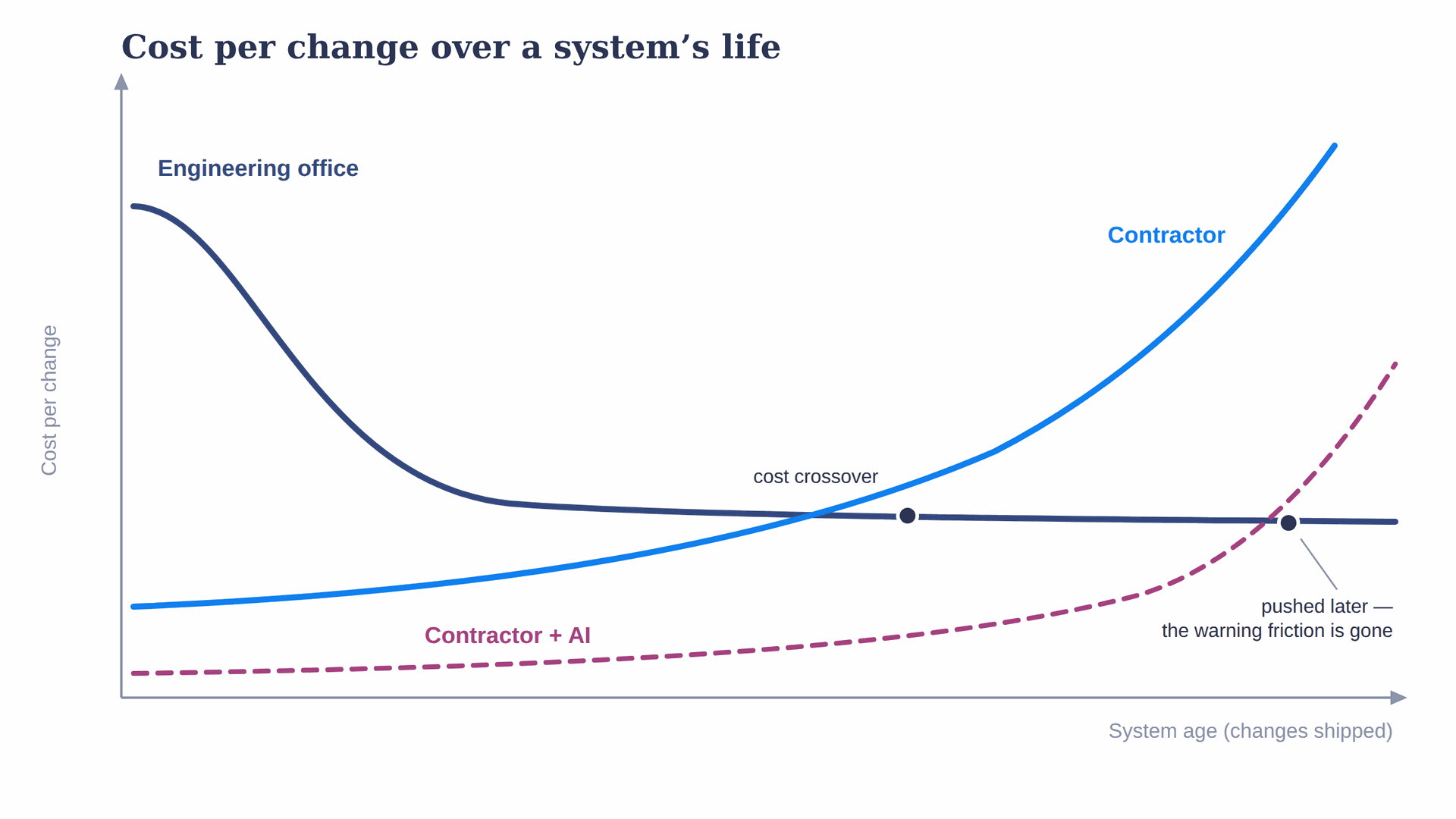
And the cost curves moved in a way that hides the problem. The contractor’s cost per fix is small and roughly flat; the engineering office’s is paid up front, then costs almost nothing per change after. Somewhere the two lines cross, and past that crossing the un-designed system costs more per change than the designed one — permanently. AI does not remove the crossing. It pushes it right and, far more consequentially, it absorbs the pain that used to signal you were approaching it. The friction that once made a team stop and say “we need to rethink this” is exactly the friction AI is best at dissolving. A team now passes the crossover without noticing — and feels productive while doing it.
AI did not move the boundary between the two roles. It made the boundary invisible. A contractor with AI does not become an engineering office. A contractor with AI becomes a contractor whose structural debt takes eighteen months to surface instead of three — which is worse, because three months is a correction and eighteen months is a rewrite.
Three defects in the same place
One architectural instrument costs nothing and needs no tooling.
Two or three defects land in the same area. To a contractor, that is three tickets — fixed and closed, throughput intact. To an architect, three defects in one place is one defect, and it is not in any of the three tickets — it is in the shape that keeps producing them. Same data, arriving in the same queue, read as two completely different things. One reading generates work. The other generates a decision.
Clustering is a signal because it is not random. Defects concentrate where a structure is being asked to do something it was not shaped to do, and the concentration itself is the evidence.
Here superspeed has its nastiest side effect: AI destroys the diagnostic value of clustering by default. The signal was never one defect; it was the third one, still fresh in view while the first two were unresolved. When each is fixed in twenty minutes, the cluster never accumulates into anything a human can see. The three tickets close on different days, by different people, in different sprints. The pattern that would have triggered a design review never gets the chance to form.
The instrument used to be applied by friction, for free. Now it has to be applied deliberately.
Most work is contractor work
None of this makes the contractor the lesser trade, and treating it that way is its own expensive mistake. There is a large class of work where hiring an engineering office is pure overhead and the contractor — especially now — is straightforwardly the right answer.
The pattern is settled and the drawings already exist. A standard e-commerce checkout. A routine admin back office. A documented payments integration. A stock ERP implementation with nothing custom in it. The design cost was paid once, by the industry. Reproducing a known pattern faithfully — brick by brick, without improvement — is the correct act; deviating from it is the error.
The framework is the stamped drawing. Rails, Django, Odoo, a component library: engineering-office output, calculated and load-tested across thousands of projects, given away for free. A contractor executing them faithfully beats an architect re-deriving them from first principles on every axis — quality, speed and cost.
Repetition at scale. Forty branches on one layout. Two hundred report variants. Thirty connectors against the same protocol. Repetition is contractor work at its purest, and AI multiplies it — here superspeed compounds a correct pattern instead of compounding a mistake.
Deliberately disposable work. A prototype whose only job is to answer a market question before being thrown away. Designing it properly is a waste of design. Ship it, learn from it, and actually discard it.
The one decision the contractor cannot skip
Every one of those wins depends on the same condition: the problem has been solved before, and you can tell. Both halves carry weight, and the second half is not a contractor’s judgment. Deciding “this is a standard job” is an engineering-office decision — the smallest one there is, and the only genuinely unskippable one, because it gets made on every project whether or not anyone notices making it. Default into it and you have not avoided the decision; you have made it by omission.
It costs an hour. It determines whether the next six months of AI-accelerated output compound in the right direction or the wrong one. And it is routinely skipped, because skipping it feels like starting immediately.
Where the engineering office is not optional
The office’s list is short, and that is the finding: the engineering office is not needed everywhere. It is needed precisely where reversal is expensive:
- Decisions that cost a hundred times more to reverse than to make. How a customer is identified across every system. Whether one installation serves one client or many. How money and time are recorded — which currency, which timezone, what “now” means to an auditor. The basic shape of how the business is modeled. None of these is hard to build; all of them are hard to change once the data has piled up on top of them.
- Rules that must hold across systems. Two systems that both believe they own the truth, and must be made to agree. An operation that must land exactly once no matter how many times it runs. Numbers that must reconcile at month-end. No single ticket ever contains one of these, which is why no ticket-driven process ever produces one.
- The promises no feature ticket carries. How much load it must take, how fast it must answer, how long it may be down, where the data may legally live, what the regulator and the auditor will demand of it. Calculated up front, or discovered in production.
- Genuinely novel problems. No reference pattern exists, so there is nothing to copy brick by brick. The design has to be derived, and derivation is the engineering office’s actual product.
- Changing the shape under load. Migration and legacy modernization — the software equivalent of underpinning a building people are still working in. This is where an unsigned drawing is most expensive — and most common.
These share one property: AI accelerates the work, but the work is deciding what is true about the business, and that decision does not get faster because the typing did.
The office’s product did not get cheaper
Both the drawings and the building
On site, the drawing and the structure are separate artifacts held by separate parties, and the inspector’s function is to check one against the other. In software they are the same artifact in two representations — design intent in the docs, as-built in the codebase — and the architect has to own both, because nobody else is positioned to notice when they stop agreeing.
Drift between them is not a documentation problem. When the doc says one thing and the code does another, a design change has already shipped without anyone calculating it. That is an unstamped drawing, discovered after the pour. The reason it goes unnoticed is that the two artifacts have different owners in most organizations, and neither owner’s job description includes the comparison.
This is also the mechanism behind the earlier point about inspection. An organization with no written design intent cannot have an engineering inspector — not because its people lack the skill, but because there is nothing to inspect against, so conformance testing is the only available form of inspection. Write the intent down and quality control becomes capable of closing the loop: the last checkpoint, verifying the built thing against what it was supposed to be. Not the designer — the closer. The loop needs both ends to exist before anyone can close it.
Same AI, opposite question
Both roles use AI heavily. It is the same tool, and it is being pointed at two different questions, which is why the outputs diverge so sharply.
The contractor’s goal is to close the item; the point of view is local; AI is a throughput multiplier. Faster fixes, more features, more parallel work, less waiting. Excellent, and correctly so.
The architect’s goal is to understand the shape; the point of view is global; AI is a comprehension multiplier. Read the entire codebase rather than the file in front of you. Find every place a pattern repeats instead of the three places you remember. Compare what was designed against what was actually built, across a whole subsystem. List every case before deciding anything. Reconstruct why the third defect landed in the same place as the first two.
| ENGINEERING OFFICE | CONTRACTOR | |
|---|---|---|
| OWNS | The drawing — design intent | The building — means and methods |
| LIABLE FOR | The design — liability outlives the project | The execution — defects against the drawing |
| UNIT OF WORK | The decision | The ticket |
| QUALITY MEANS | Fitness — the drawing is right | Conformance — zero defects against the drawing |
| THREE DEFECTS IN ONE PLACE | One defect, in the shape | Three tickets |
| USES AI AS | A comprehension multiplier — read the whole system | A throughput multiplier — clear the queue |
| IN THE OTHER ROLE, IT | Re-derives settled patterns at full price | Accumulates structural debt that surfaces months later |
The second list is the one the industry has mostly missed. Global comprehension is exactly what architecture always needed and could never afford — holding an entire system in view at once was limited by how much one person could keep in their head. That constraint just lifted. The most under-exploited use of AI right now is not writing code faster; it is reading a system completely enough to know what its real shape is.
The same speed clears the queue for one role and makes the whole building visible to the other.
The threat points the other way
The conventional reading of AI in this industry is that it threatens the expensive senior people and empowers the fast delivery shop. The mechanics point the other way.
The contractor’s advantage was throughput — more hands, better tooling, tighter process, faster delivery of a known pattern. That advantage is precisely what AI commoditized and handed to everyone, including the client. When execution speed approaches free, it stops being a differentiator, and what remains is the quality of the decisions that execution was serving.
That quality of decisions is the engineering office’s product — the one thing on the site that did not get cheaper.
What’s on our wall
Printed and hung, because it settles an argument before it starts:
We are the engineering office. Our software engineers are the supervisors on site. AI is the construction contractor.
Everything above describes the two firms as the industry has them: you engage a contractor, the contractor engages people, and lately the contractor engages AI. That reading is accurate about the market. It is not the assignment we run on.
The contractor is not a company we hire. It is the tool, and it does what a contractor does — means and methods, volume, the thousand on-site decisions that turn a drawing into a building. Fast, tireless, genuinely skilled, and structurally incapable of asking whether the drawing is right.
The engineer, then, is not the contractor and not an architect working alone. The engineer is the supervisor: on site, watching the pour, holding the drawing, carrying the authority to stop the work. That is the inspector from the opening of this post: authority and a drawing, in one person, standing where the work happens.
And the tool does not stay on site. The same AI is consultancy inside the engineering office — the one who has read every code, every reference project, every precedent, and will run the calculation forty ways in an afternoon. And it is the supervisor’s assistant, reading the whole system when a defect lands instead of only the file it landed in.
Three roles, one tool — and they stay three for one reason. In each of them AI does what it is superb at: drafting options, executing volume, reading exhaustively. In none of them does it hold the stamp. The stamp is the one thing that cannot be delegated, because it is not a capability — it is liability that outlives the project. A consultancy advises and the office signs. A contractor builds and the office answers for what was built. A supervisor stops the work under authority the office granted.
This gives a test for every “AI-native” claim, ours included. The measure is not how much of the work AI does — that number should be large and rising. The measure is who stamps the drawings. A shop where AI is the contractor and nobody holds the drawing has not become an engineering office. It has become a site with no engineering office at all — building faster than ever, in a direction nobody calculated.
Every project already runs on an assignment of these roles — yours included, written down or not. The question worth answering is whether it was decided, or just what happened.